

Since the so-called “End of History,” (at the very least), many people (especially those who look like me) on Turtle Island have been living in a general state of “colonial unknowing” and a fake sense that their immediate world is extraordinary safe and peaceful (at least domestically). I have a hunch that this bubble of willful ignorance is popping (or at least, shrinking).
From Land and Water Defenders shutting down “Canada” in 2019 and 2020, to the Black Lives Matter Uprisings of 2020, to the massive opposition to “Western”-backed genocide in Palestine, to the TikTokers getting newly radicalized on a Chinese social media app that sounds a lot like, but is not, in fact, named after Mao’s Little Red Book, to the popularity of a certain alleged political assassin, I think there is real cause for cautious optimism about about the widening political imagination of many Canadians and Americans. As we rise to fight the tide of global fascism and authoritarianism more broadly, one recent history holds a lot of insight and provides another crucial arena for international solidarity: The Syrian Revolution.
Mere months ago, I would have said the most exciting thing happening in and around Syria (maybe in the world) is The Democratic Autonomous Administration of North and East Syria (DAANES, aka “Rojava”). And that is, absolutely, an exciting project that gives me grounds atop which I construct my daily practice of hope (if you’re unfamiliar, give a listen to The Women’s War for some fascinating investigative journalism on the project), but DAANES, like all things, is flawed, as is the way it is often read and talked about. DAANES gets much well due attention and praise for its military successes against ISIL/Daesh, its ideological contentedness to the ever googleable Murray Bookchin, and its pretty substantial internationalist orientation and support (though it could certainly use more). All of these are good reasons to celebrate and follow DAANES. Ditto its feminism/Jineology, communalism, and anti-state orientation.
And yet, in the wake of the fall of Assad and the Ba’ath Party, and thanks to stumbling upon Leila Al-Shami on the Fediverse via https://niagara.social, my renewed interest in and around Syria and the Syrian Revolution is much more fulsome. The struggle in Syria is so much bigger then DAANES and it is incumbent on internationalist leftie folks to heed that, support, learn from, and remember the past and present of the Syrian Revolution.
Al-Shami shared the “Remember Omar Aziz” website (https://rememberomaraziz.net/) which has a free and incomplete book, The Syrian Revolution: a Reader, a collection of various pieces on the Revolution including some by both Aziz and Al-Shami. Accordingly, in effort to draw attention to the wider on-going revolution in Syria and to celebrate and remember Omar Aziz, I’m going to review it, and encourage you to check out the site and support the revolution however you can. Just because Assad is gone, doesn’t mean the revolution is over or won.

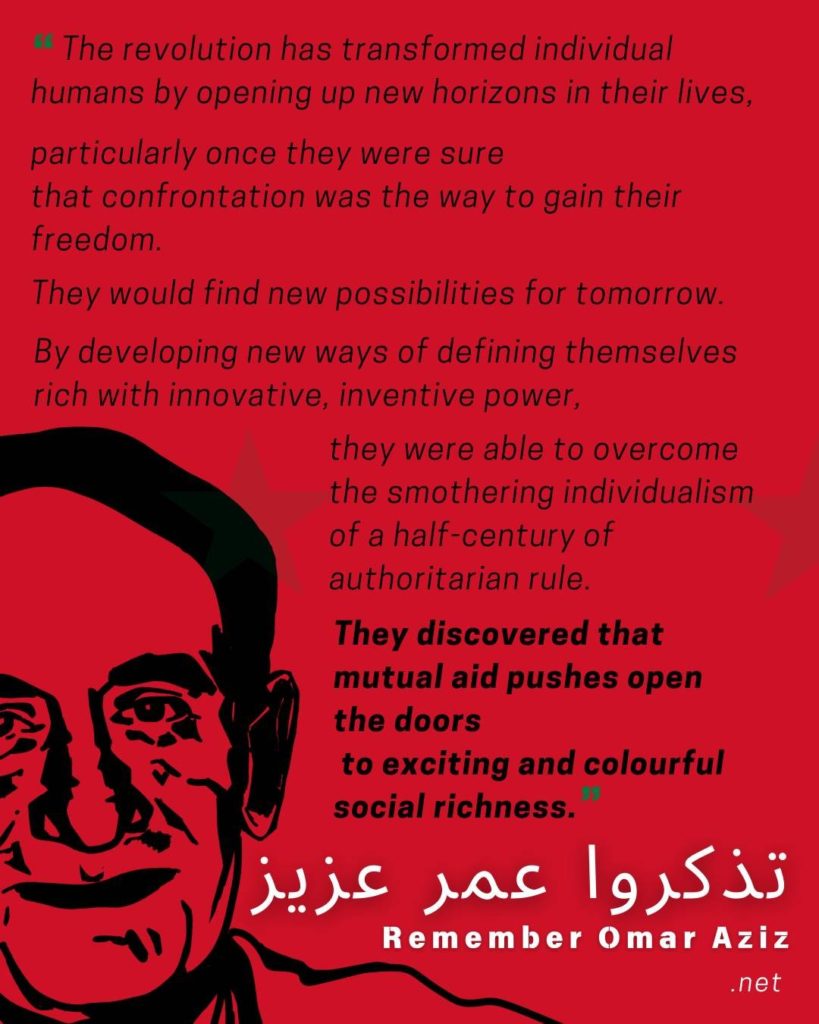
Omar Aziz died on February 16th, 2013 presumably due to the poor conditions of the prisons he was locked in. He was an exiled Syrian anarchist who returned to the country in his 60s when the revolution started. He celebrated and joined in on the outbursts of mutual aid that often happen when states falter. There, Aziz proceeded to envision, inspire and help to establish Local Coordinating Councils (LCC) whereby community members could meet and organize their lives democratically amidst brutal repression from the Assad regime on one hand, and fascist Islamist groups on the other. “Coordination” is key here because his vision helped to develop horizontal/non-hierarchical linkages between protest and mutual aid movements.
The LCCs helped people from all walks of life, social position and profession, learn to do the day-to-day work of revolution and of enacting power in their communities via direct action and mutual aid to provide communications, food, water, healthcare and more. Another goal of the LCCs was the unification of peoples’ every day lives with their revolutionary lives which Aziz argued were separated (where folks would go to a protest in the evening and go about their normal state-imposed hierarchical life during the day, for example). These LCCs then were a form of anarchistic dual power in which communities worked to build up parallel competing infrastructure to that of the state in hopes to live the revolution into being and eventually lead to the dissolution of the state in favour of direct action, mutual aid, and democratic cooperation.
Omar Aziz stood for the complete break-up with the state in order to achieve collective liberation without waiting for regime change or for one ruling power to replace another. He believed that communities are capable of producing their own freedoms regardless of political vicissitudes. (Muhammad Sami al-Kayyal qtd. in Hassan)
If you’d like to read more about the LCCs and how Aziz envisioned them, one of his most substantial writings about them are translated and archived here: https://north-shore.info/2020/09/30/to-live-in-revolutionary-time-on-the-formation-of-locals-councils-by-omar-aziz/ thanks to the good folks at North Shore Counter-Info.

The unfinished anthology is just that: unfinished. It lacks polish, repeats itself, and is, of course a free PDF from a website rather than a paper book you could get at your local library or indie bookstore, not to mention the fact that the last chapters have yet to be written. But. I think that reading the Reader as it is right now provides pathways into the history and present of the Syrian Revolution. It shows us comics, poetry, journalism, essays and more, and it links back to where readers can dive deeper into the subject matter. Do I suggest you read it in in its current state? It depends on what you’re willing to tolerate, and what you know of the revolution or revolutions or anarchism thus far. If your answer is “not much,” then I think you should hold off until the Reader is finished and instead direct your attention to the page of resources at the end of it, and the other recommendations on the “Remember Omar Aziz” website.
One of the most striking revelations in the book is how surprised many of those already engaged in revolutionary work in Syria were when the revolution actually broke out. And yet it was much of their precursor work that enabled what we might call the revolution’s long-term successes. I am drawn to my crestfallen comrades in my heart and community who have all but given up on mass social change, even from our comfortable position basking in the warmth of the empire’s hearth. Syria shows us both what is possible and what we must do to prepare.
When one looks at the Syrian reality, it instills deep despair in you, but when you insist on the priority of hope, you think, imagine and act differently. I cannot ignore a crushing reality, but I prefer to start from hope: doing things in ways that keep hope alive. (Yassin al-Haj Saleh, Reader, 104)
One of DAANES’s most noteworthy aspects is its feminism/Jineology (as mentioned above) and while it seems to me that the Syrian Revolution as a whole doesn’t necessarily have as much ideological coherence as “feminism” or “democratic confederalism” or whatever, it often exhibits a practical feminism and certainly communalism as exemplified by the by the rather simple fact that two of the “Douma Four” (99) are women: Samira al-Khalil and Razan Zaitouneh who also helped to established the LCCs (73). Both al-Khalil and Zaitouneh have work featured in the Reader, and al-Shami has a piece entitled, “Fighting on All Fronts: Women’s Resistance in Syria” (73-76) where she provides many examples of strong women revolutionaries including the ways that these women are vital to civil resistance and organizing. She ends the piece with a call for “western feminists and the left” to support these women and the revolution they are bringing about (75).
Elsewhere in the reader, Robin Yassin-Kassab and al-Shami argue that “you can’t build a democracy for other people, only people themselves can do it” (Yassin-Kassab 44). They argue that sometimes DAANES’s way of doing things (really, the PYD/PKK) means that they are conquering new territory and imposing their democratic confederalist vision on those people in the new territory to mixed effect, as opposed to what’s happening (or, happened) in other parts of the Syrian Revolution where people build democratic projects together and therefore are perhaps harder to parse for international observers. The irony here is obvious, when bottom-up, horizontal power is externally imposed by a single power, it is legible and gets support from the international community who can understand what has happened and full-throatily support it, but when people themselves build bottom-up horizontal power, even supporters of those ideas and structures have a hard time seeing and validating it amidst the confusion and propaganda. I’ll leave you with a few more words on Aziz and the Syrian Revolution from some folks who know much better than me what’s going on:
While most leftist Arab and Western intellectuals robotically lecture the “masses” about Foucault, Marx and Sartre atop their ivory towers in a pretentious and complex language, Aziz and his comrades in Douma, Zabadani and Harasta gave life to the dead texts and tried to practice them on the ground amidst the crackdown. (Hassan)
Assad is gone, but the fight against fascism must continue. Long live Omar Aziz! And long live the Syrian Revolution! Also, you should definitely follow @leilashami for the latest updates:
Bibliography and References
Sethness, Javier. “Omar Aziz, ‘Abu Kamel,’ 1949-2013: Biography, Readings, Quotes.” Black Rose/Rosa Negra Anarchist Federation, 27 Sept. 2018, https://www.blackrosefed.org/omar-aziz-biography-readings-quotes/.
“After a Winter of Blockades: Updates on Criminal Charges from #ShutDownCanada.” It’s Going Down, 13 Jan. 2021, https://itsgoingdown.org/after-a-winter-of-blockades-updates-on-criminal-charges-from-shutdowncanada/.
al-Zeer, Majed. “Amid Genocide, the Tide Is Turning on Palestine.” Al Jazeera, https://www.aljazeera.com/opinions/2025/1/10/amid-genocide-the-tide-is-turning-on-palestine. Accessed 21 Feb. 2025.
al-Shami, Leila (@leilashami@spore. social). “‘Against Tyrannical Dictators. Against Colonial Invaders. Syria Is Free!’Massive Protests Erupted on Tuesday in All Syrian Cities in Rejecti….” Mastodon, 26 Feb. 2025, https://spore.social/@leilashami/114069810641696499.
al Shami, Leila. “The Life and Work of Anarchist Omar Aziz, and His Impact on Self-Organization in the Syrian Revolution.” The Anarchist Library, https://theanarchistlibrary.org/library/leila-al-shami-the-life-and-work-of-anarchist-omar-aziz-and-his-impact-on-self-organization-in. Accessed 21 Feb. 2025.
Aziz, Omar. “To Live in Revolutionary Time: On the Formation of Locals Councils.” North Shore Counter-Info, 30 Sept. 2020, https://north-shore.info/2020/09/30/to-live-in-revolutionary-time-on-the-formation-of-locals-councils-by-omar-aziz/.
Chen, Jianqing. “What’s Happening on RedNote? A Media Scholar Explains the App TikTok Users Are Fleeing to – and the Cultural Moment Unfolding There.” The Conversation, 19 Jan. 2025, http://theconversation.com/whats-happening-on-rednote-a-media-scholar-explains-the-app-tiktok-users-are-fleeing-to-and-the-cultural-moment-unfolding-there-247621.
“Communalism and Especifismo.” Usufruct Collective, 5 Aug. 2021, https://usufructcollective.wordpress.com/2021/08/04/communalism-and-especifismo/.
Evans, Robert. https://www.thewomenswar.com/. Accessed 21 Feb. 2025.
Gottbrath, Laurin-Whitney. “In 2020, the Black Lives Matter Movement Shook the World.” Al Jazeera, https://www.aljazeera.com/features/2020/12/31/2020-the-year-black-lives-matter-shook-the-world. Accessed 21 Feb. 2025.
Hassan, Budour. “Omar Aziz: Rest in Power.” Random Shelling قصف عشوائي, 19 Feb. 2013, https://budourhassan.wordpress.com/2013/02/20/omar-aziz/.
Internationalist Commune. 20 Feb. 2025, https://internationalistcommune.com/.
“Jineology.” Wikipedia, 18 Dec. 2024. Wikipedia, https://en.wikipedia.org/w/index.php?title=Jineology&oldid=1263823379.
Luigi Mangione Legal Defense Information. https://www.luigimangioneinfo.com/. Accessed 25 Feb. 2025.
Madwar, Samia. The Day Assad Fled: Joy, Fear, and the Weight of History | The Walrus. 10 Dec. 2024, https://thewalrus.ca/the-day-assad-fled-joy-fear-and-the-weight-of-history/.
Pearson, Emma, and Katie Welsford. “The Silencing of the Douma Four: Still Missing, One Year On.” Middle East Eye, 13 Feb. 2015, https://www.middleeasteye.net/features/silencing-douma-four-still-missing-one-year.
“Radical Lives: Omar Aziz.” Novara Media, https://novaramedia.com/2015/02/23/radical-lives-omar-aziz/. Accessed 21 Feb. 2025.
Remember Omar Aziz – February 16, 2025. https://rememberomaraziz.net/. Accessed 22 Feb. 2025.
Staff, Al Jazeera. “Who Is Abu Mohammed Al-Julani, Leader of HTS in Syria?” Al Jazeera, https://www.aljazeera.com/news/2024/12/4/who-is-abu-mohamad-al-julani-the-leader-of-hayat-tahrir-al-sham-in-syria. Accessed 21 Feb. 2025.
“Syrian National Dialogue to Begin on February 25.” Reuters, 23 Feb. 2025. Reuters, https://www.reuters.com/world/middle-east/syrian-national-dialogue-conference-begin-february-25-preparatory-committee-says-2025-02-23/.
“The End of History and the Last Man.” Wikipedia, 3 Jan. 2025. Wikipedia, https://en.wikipedia.org/w/index.php?title=The_End_of_History_and_the_Last_Man&oldid=1267023643.
The Syran Revoloution: A Reader. 2nd ed., https://rememberomaraziz.net/, 2024.
Vimalassery, Manu, et al. “Introduction: On Colonial Unknowing.” Theory & Event, vol. 19, no. 4, 2016. Project MUSE, https://muse.jhu.edu/pub/1/article/633283.
Updates
2026/03/17: Fixed citations, typos, and reformatted a quote.



Leave a Reply to kostyn.ca Cancel reply