
After the explosion of “Canada’s meat-poisoned eccentric,” in the mid-20 teens, I found myself on the floor of my studio apartment in Aarhus with a pen, spiral-bound notebook, and a pair headphones, determined to figure out what Jordan B(althazar) Peterson was arguing. I desperately wanted to know what was valuable in his argument and above all else, why people who typically looked just like me (white dudes) were so in love with him. So, for hours, I listened to all of his appearances on the Joe Rogan show (another mystifying figure) mapping each of Eatmeaterson’s points. During this process, I started to realize as many have, that he was arguing nonsense paired with a small handful of obviously good self-help nuggets. Points would contradict one another or be patently false, or seem utterly irrelevant. Needing to understand Peterson was personal too because I had a friend who liked some of his stuff and so, I thought, there must be something there, but it turned out, there wasn’t and I had just wasted most of a day trying to make sense of incoherent ramblings. At the end of that fruitless exercise, I tore the enormous argument map I’d drawn up out of the notebook and crumpled up both it and my lingering liberalism.
I say liberalism, though I was more of a social democrat at the time, after all, one of my reasons for going to Denmark in the first place was to see the “Nordic Model” in action. But of course, democratic socialism holds in it a lot of liberal values emblematic of my desire to hear this bad actor out. So-called, “liberal democracies,” famously fail to address the “paradox of tolerance” wherein to foster a truly tolerant society, intolerance must not be tolerated (although, Germany’s spook agency’s way-too-late assessment of the AfD is worth watching). There must be countless reasons for this, but at the heart of these perpetual failures to effectively combat fascism, is an inability to apply careful study of history the current end-of-history all-sides-are-equally-valuable societies we live in. Margret Thatcher, godmother of neoliberalism, famously said, “there is no such thing as society,” (Klein 232) and if you believe that to be true, how can you see, let alone prevent, intolerant currents in society? As always, ascribing motive or intent to arguments from someone like Peterson and his ilk and their followers is fraught, since their arguments often “don’t make sense,” it’s hard to say if that’s a “tactic” or a “symptom” of fascistic rhetoric, but regardless, we ought to treat it the same. It’s bullshit all the way down, I’m afraid.
Some time later, a good friend of mine fell into the same trap, and every phone call with him for what must have been a year devolved into him exasperatedly trying to make sense of Petersonites to the point that I felt it was affecting his mental health, so I would say something like, “I don’t think making sense is the point, it’s more about scoring points in a game they’re making up on the fly fed by memes from their political subculture,” and try to move us elsewhere. As soon as we assume a legibility of fascistic argumentation, we’ve lost ground and they are gaining adherents by the minute. Both Ian Danskin’s, Innuendo Studio’s (RIP and send money his way) “The Alt-Right Playbook” series helped clarify my thoughts on this along with Behind the Bastards which lead me to the most influential piece on my thinking: Umberto Eco’s “Ur-Fascism.”
Eco grew up in fascist Italy and he, like many boys at that time and place, participated in competitions for fascist children, and so is keenly aware of how fascism operates at the social level. In “Ur-Fascism,” Eco writes about 14 features he argues have the potential to “coagulate” into fascism (5). Crucially, he observes that all fascist movements are unique, and the presence of one or more of these elements in any given society can lead it to fascism (5), and so it follows that the more of these that are present, the more likely that the society will become fascistic/give rise to fascistic movements. While the whole (short) essay is one of the few pieces of writing I’d consider a must-read, there are a couple of features I’m going to focus on here. In doing so, keep in mind Eco’s caveat that some of the features contradict one another and even themselves. For me, and for my friend, and I’m sure for many others, the inconsistencies and moments of clear contradiction are tantalizing. But they are the sweet stickiness of political fly paper. Do not engage.
Fascism isn’t supposed to make sense and that is part of its appeal. Eco calls this “a rigid discombobulation, a structured confusion.” He says that, fascism acts on the level of emotional responses to cultural archetypes, which is why Hitler and Goebbels didn’t actually believe that the made-up The Protocols of the Elders of Zion document was literally true, but rather that it contained an “inner truth” about an international Jewish conspiracy or Jewish character more broadly (Bytwerk).
The first of Eco’s features is “the cult of tradition” (5) which must be “syncretistic,” meaning that it takes a whole bunch of ideas from a wide range of sources (often “ancient” in nature), many of which contradict one another. Movements that espouse this fascistic feature believe in a capital-T Truth, like that “inner truth” of the known-hoax document mentioned above. Eco says that, “If you browse in the shelves that, in American bookstores, are labelled as New Age, you can find there even Saint Augustine who, as far as I know, was not a fascist. But combining Saint Augustine and Stonehenge – that is a symptom of Ur-Fascism” (6). Eco also says in features two-to-five that fascism hates thinking and views it as “a form of emasculation,” (6) and so it hates modernity (not to femininity except within very rigid boundaries), societies purportedly based on scientific knowledge and complicated uncertainties. So, Eco also defines Ur-Fascism as “irrationalism” (6). Fascist thinking is not about analytical reason, it is about knowing what is True, to disagree with the Truth is, well, “treason,” and must be punished accordingly (6). The fifth feature Eco articulates is the forcing of a consensus based on “fear of difference,” which is where the racism comes in (6). “Disagreement,” says Eco, “is a sign of diversity,” fascism, or proto-fascism, argues that disagreement must not be tolerated (6). For example, if we believe that there have always been two genders and that they align with physical features of our sexed bodies that can be predicted from birth, research demonstrating the astonishing diversity of genders throughout history and into the present can only be a trick! Something that our enemies claim to believe but which is not part of the Truth and therefore must be combated.
A worry I have about this way of explaining fascistic argumentation (as an emotional appeal to grand narratives as opposed to solid analytical critique) is that it may seem to privilege analytical thinking over emotionality, and suggest that one can do analysis without emotion. Or that it suggests that emotionality is predisposed to fascistic thinking. To be clear, it is not. Rather, I’m begging those of us who, like me, default to the analytical mode to explain the world, to engage with the world as it is emotionally, especially with others. I know that this is no small feat. The biosphere is dying, fascism is swallowing societies whole, and while the steps to avert these catastrophes are available, the movements we have to implement them and avert the worst of their effects seem small and ineffective. I think that if we fail to successfully use the emotionality fascism takes advantage of, we are bound to fail. There is of course, much more to fascism than what I’ve been able to summarize here, and I can’t recommend you read the essay enough, but for the sake of this discussion, we must move on.
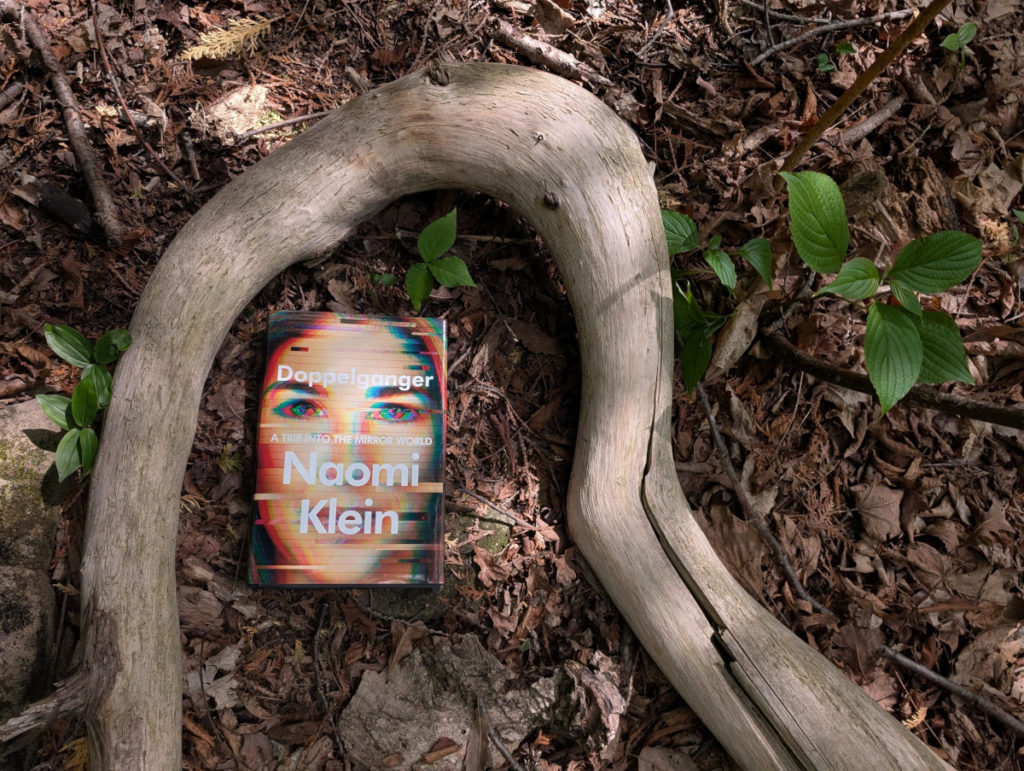
This brings us to the book review. Naomi Klein’s 2023, Doppelganger: A Trip into the Mirror World, is the most thoughtful and successful analysis regarding what exactly is going on with today’s fascist irrationalism that I’ve come accross, especially given how much the first half of what fascists say tends to sound pretty reasonable: “Everything is fucked,” “politicians are fucking us over,” “we need to destroy the system and make something new,” “they’re destroying freedom,” “elites are ruining the world,” “the poor and middle classes are suffering,” “society is collapsing,” etc.. All those opening statements are things both a fascist and I might say (if phrased a little differently). So, at that level, I agree with some of them and they agree with some people like me. It’s only when we press a little harder on those sentiments that we find stark contrasts. I might say “Everything is fucked because capitalism incentivizes rich elites to act only in ways that benefit the profit margin of their investments and since infinite financial growth is pushing against the physical, finite limits of the Earth, and they tend to use convenient ‘divide and conquer’ tactics to foment crises in representative democracies by buying politicians and or amplifying the voices of fascistic demagogues into power.” My argument is one focused on systems and power. It is analytic and I recognize where it fails to capture the unique ways some are more “fucked” than others and how fucked the use of “we” is here. But a fascist might say that “Everything is fucked because woke DEI liberal elites are ruining the economy by pushing an environmentalist conspiracy designed to take away individual freedoms and turn us into mindless drones.” Notice how I blame social systems, and the fascist blames individuals and their perceived loss of status especially with regard to race? Well, perhaps my straw man isn’t doing this argument justice and maybe a fascist might blame the “woke mind virus” instead, which is a pattern of discourse, I suppose, or they might blame a globalist (read “Jewish”) conspiracy. Regardless, as I’ve stressed, the details aren’t the important thing here. It’s an emotional appeal. Hence, as Klein notes, “anti-Semitism is sometimes referred to as ‘the socialism of fools,’ a phrase coined by the Austrian democrat Ferdinand Kronawetter and popularized by Social Democrats in Germany in the 1890s” (286). Rather than analysis, fascistic thinking produces and agitates emotional archetypal narratives.
Okay, the book, the book. There is an ancient hymn passed on by internet forebears which holds in it a truth so powerful that it is silenced! Censored, I tell you! And I quote it here because it is conveniently written in a best selling book and readily available in every review of Doppelganger, as well as all over the internet, so we can gain some of it’s power and build … a Galactic Empire!
If the Naomi be Klein
you’re doing just fine
If the Naomi be Wolf
Oh, buddy. Ooooof. (27)
Klein and her real-life doppelganger, Naomi Wolf, form a strange tale of two Naomis. Doppelganger chronicles Klein’s inadvised journey into the nature of the frequent case of the mistaken Naomis (in articles, on TV news, on Twitter, in conversations in bathrooms, all over) and therefore into the life of her doppelganger, Wolf, who was a feminist writer before the premise of one of her books fell apart live on TV and she became radicalized to the right. For awhile, she was the token liberal on right-wing podcasts and videos. She would be there to confirm that yes, in fact, even a feminist thinks this is nuts. And she uses this identity to get her into these spaces to the point where she became a frequent guest on Steve Bannon’s (of Breitbart, out-spoken literal fascist who was the chief strategist for Trump’s first term) podcast. Klein had been avoiding the two Naomis confusion for years (27), but Wolf slowly moved away from writing books about feminism to writing books about American politics that cover topics freakishly similar to the ones Klein writes about up to and including literally the same proposal, the Green New Deal. Klein began to feel like she had to get to the bottom of this confusion and read about the history of doppelgangers and especially their appearances in literature to try to uncover what the heck she is supposed to do with this conundrum. And she learns that, you cannot ignore your doppelganger, you must confront them and that confrontation will inevitably be a confrontation with yourself.
Thanks to Klein’s body of work doing in-depth research and theorizing about some of the largest issues of our time: fascism, climate crisis, colonialism, disaster capitalism, war, genocide, and the movements to oppose all of these, a closer look at her life and works provides a closer look at recent history. What she does with this book is not debunk the bad ideas of her right-wing doppelganger, but to explore the relationship between what we say, what we believe, and so-called “reality.” She looks at how ideas can take someone from one place and lead them to other ideas that may or may not coagulate into fascism or fascist tendencies. How does one get from feminist hippies, to antivaxxers, to climate deniers, to white supremacists? The twin realities observed by Klein, and to some extent, Eco, one based in fact and analysis, another based in conspiracism and fanaticism are our “worlds.” The right-wing conspiracy world is what Klein terms, “the Mirror World,” where things almost seem like they make sense, the pieces almost all fit together, but it’s a twisted world based on fear and xenophobia and, well, you’ll see if you read the book.
I think that while it is vitally important not to fall into the trap of taking apart fascistic arguments and going, “ta-da! These are bad ideas and since I’ve proved that, no one will adhere to them,” we must also learn to understand the movements in culture that brew fascism, not to mention the full blown fascist ones. In doing so, some of us can scratch that debunking itch with those of us who already agree that the arguments are bad, as Klein does from time-to-time, and move on to cutting fascism down.
It is as if Klein has taken Eco up on his call to, “keep alert, so that the sense of these words will not be forgotten again. Ur-Fascism is still around us, sometimes in plainclothes.” He pines, “It would be so much easier, for us, if there appeared on the world scene somebody saying, ‘I want to reopen Auschwitz, I want the Black Shirts to parade again in the Italian squares.’ Life is not that simple. Ur-Fascism can come back under the most innocent of disguises” (8), like your local whole foods organic grocer or a Facebook group for local moms.
Doppelganger is a must-read for everyone who wants to know how we got to fascism in the 21st Century, what and why they think what they think, and what lessons this has for our own anti-fascist movements. It’s for people who want to know what the appeal of fascistic rhetoric is, and learn many of the tactics they use to keep gaining ground. It’s for those who, like me and my friend did, think there’s gotta be something there behind all of the bullshit in the mirror world, and there is, it’s our reflection. Klein argues that much of what makes the modern world so susceptible to conspiracism is the real horror of our greater or lesser embeddedness in climate collapse, racial capitalism, war, genocide, starvation, poverty, and violence, as well as our own impending deaths made even more present (for some of us) thanks to these very same forces. No one wants to have a hand in these horrors and yet, most of us do. There is a lot of comfort in conspiracism. Certainty about how the world works, about how to get back what was lost, heroes and villains. They are comfortable lies that can be used to shield us from the messy world. How can liberatory movements help people to see that messiness for what it is, accept it, and move on?
In the past couple months I’ve watched Edward Berger’s Conclave (2024) four times. It might be my favourite film at this point. And I keep coming back to Ralph Fiennes’s character, Cardinal Thomas Lawrence’s homily at the start of the Conclave: “Certainty is the great enemy of unity. Certainty is the deadly enemy of tolerance. … If there was only certainty and no doubt, there would be no mystery and therefore no need for faith. Let us pray that God will grant us a Pope who doubts. Let Him grant us a Pope who sins and asks for forgiveness, and who carries on” (00:36:00-00:37:50). I don’t believe in a god, and I certainly don’t believe in individuals on earth with more or less access to whatever is divine. I believe that people are fundamentally just people. Maybe there are some who trend more toward wickedness and some who trend more toward kindness, but I think good people and bad people don’t exist. We are all just complicated. So I’m not asking a god to grant us the right man for the job, I’m asking my fellow human beings to bring about a world where we celebrate mystery and difficulty, unity and tolerance, diversity and making mistakes and moving on. To do so, we have to reflect on ourselves, on our movements, on the utopian visions we’re striving for (why would you strive for anything less?), and that includes where we are failing, where we are weak and selfish, not because that’s our essence, but because it is part of our lives and to ignore that is to cede whole elements of the human experience to intolerance.
Bibliography
Being a Youtuber Bankrupted Me. Directed by Ian Danskin, Innuendo Studios, 2025. YouTube, https://www.youtube.com/watch?v=vlf8c8SV39o.
Bytwerk, Randall L. “Believing in ‘Inner Truth’: The Protocols of the Elders of Zion in Nazi Propaganda, 1933–1945.” Holocaust and Genocide Studies, vol. 29, no. 2, Aug. 2015, pp. 212–29. Silverchair, https://doi.org/10.1093/hgs/dcv024.
Conclave. Directed by Edward Berger, Focus Features, 2024.
Eco, Umberto. “Ur-Fascism, or Eternal Fascism: Fourteen Ways of Looking at a Blackshirt.” The New York Review of Books, June 1995, https://www.nybooks.com/articles/1995/06/22/ur-fascism/. https://theanarchistlibrary.org/library/umberto-eco-ur-fascism.
Evans, Robert. Part One: The Jordan Peterson Episode. https://www.iheart.com/podcast/105-behind-the-bastards-29236323/episode/part-one-the-jordan-peterson-episode-72770473/.
—. The Birth of Spanish Fascism, Part 1. https://www.iheart.com/podcast/105-behind-the-bastards-29236323/episode/behind-the-insurrections-the-birth-76754174/.
Klein, Naomi. Doppelganger: A Trip into the Mirror World. Alfred A. Knopf Canada, 2023, https://naomiklein.org/doppelganger/.
Moritz, Aaron, and Shawn Vulliez. 326 – Freaky Pierre Wants to Destroy Canada. 326, https://srslywrong.com/podcast/326-freaky-pierre-wants-to-destroy-canada/.
“Paradox of Tolerance.” Wikipedia, 17 May 2025. Wikipedia, https://en.wikipedia.org/w/index.php?title=Paradox_of_tolerance&oldid=1290809219.
The Alt-Right Playbook. Directed by Ian Danskin, Innuendo Studios, 2017, http://www.youtube.com/playlist?list=PLJA_jUddXvY7v0VkYRbANnTnzkA_HMFtQ.
Yang, Maya. “Germany Hits Back at Marco Rubio after He Panned Labeling of AfD as ‘Extremist.’” The Guardian, 3 May 2025. The Guardian, https://www.theguardian.com/world/2025/may/03/marco-rubio-germany-afd.
Edits
2025/05/22 corrected a few grammatical errors and made it clear that Wolf and Klein are real people who are often confused for one another.
Leave a Reply