
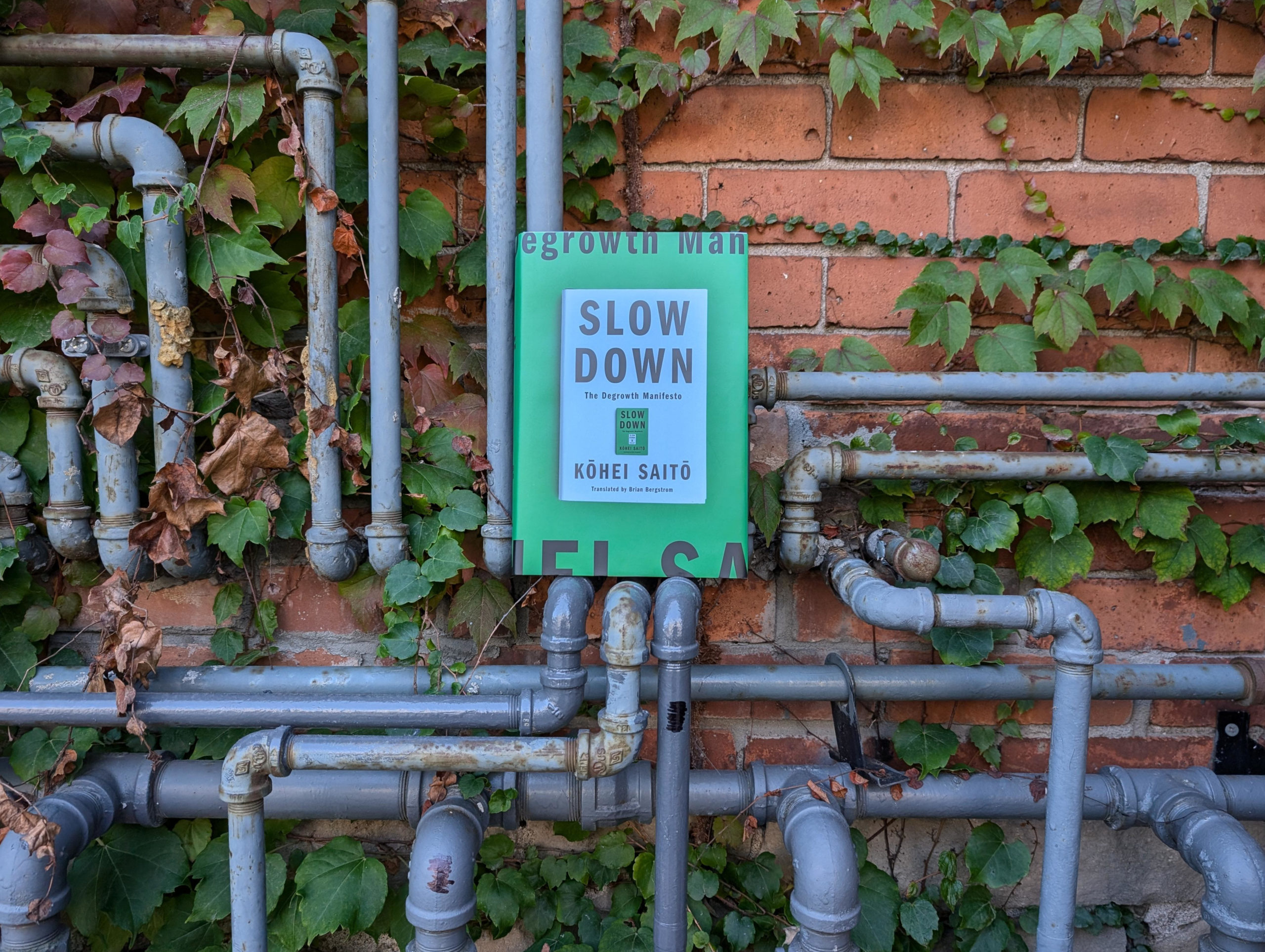
I’m sill not sure what to do with this blog, so, here’s a book review and some ramblings. I’ve been working on it for too long, and need to just rip the bandaid off, so here we go.

I tell this story a lot, but indulge me, I review a book this time. In Summer of 2017, I worked for a municipality doing landscaping and park maintenance. Having grown up with the ever (and increasingly) present climate and biodiversity crises, I was coming to the realization that things are, well, looking bad and I, as an individual, have very little agency over the problem (this was years before I started doing actual organizing and about a year before I saw a therapist for the first time). I was (and am) haunted by images of drowning refugees, of crowds at boarders and of white supremacist police, militias, and boarder security (if there is a difference…) letting people starve and die or shoot into crowds as a result of the environmental crises spurred on by the rich of the so-called “West”/Global North/Global Minority. On the drive to work, I cried every single day.
And then, at the end of that Summer, I got on a flight to Denmark and spent a year going to school abroad. I’m white and my family is upper middle class/petite bourgeois and so I had a great time. I lived like a Northern European student for 10 or so months and it was glorious. I got as good as I’ve ever been at guitar, I wrote songs and blogs and poems and essays and I met people from all over the world and made several intimate wonderful friends for whom I will always be grateful.
While abroad, I shifted my emotional relationship to environmental crises and the neoliberalism and fascism that deepens it all to an intellectual one. As a white guy (er, amab queer), I am excellent at intellectualizing the mass suffering of others. But this meant that I could function. In fact, I was high functioning.
When I came home, Greta Thunberg’s Climate Strikes started going viral and I did some digging for a local Extinction Rebellion (XR) chapter. Lo and behold, a few really good folks had registered a chapter and through them I got involved in my first actual political organizing.
Because of the virality of the 2019 Extinction Rebellion and Fridays for Future movements, our XR chapter committed to putting together a Global Climate Strike on a Friday in our small city. Over the course of a few Summer months we put various pieces together until we (or at least, I), started to sweat. Projected numbers for the events started to balloon far past what I as brand new organizer was comfortable with. It went from dozens to hundreds in a matter of hours which for our small city of less than 200000 people, was huge. Suddenly there were safety concerns and a lot of legal concerns. The right of assembly is enshrined in the Charter, sure, but so so so much can go wrong with an outdoor event and hundreds of random people. Just ask an insurance company… bathrooms, “property” “damage,” fights, equipment failures, fire! flood! electrocution! liquefaction! you name it.
So, I skipped the first half of a class to run across campus to an “Activist Meetup” so I could talk to some people who knew what the hell they were doing and thank fucking god the staff at OPIRG Brock was willing and able to help. Over the course of a month, they ranged together a comprehensive team of organizers and brought many minds together over many cups of coffee and slices of vegan pizza and we figured it out. In spite of that sickly feeling building inside of me, the event went off without a hitch (though all those organizers were burnt out for a full calendar year from their month of horror-show organizing). In the months that followed, I dug deeper and deeper into local organizing and further away from explicit “climate activism,” and of course, I have a few stories for another time, but I want to fast-forward to last summer.
The wildfires of 2023 in “Canada” covered much of this country, including my city, in thick smoke. I was and had been burnt out for years and now, suddenly, the climate crisis was in my lungs in a way I couldn’t just intellectualize. A close friend, and movement mentor of mine often remarked that white settlers can’t do good climate organizing because the issue doesn’t really affect them yet; if this was ever true, it is no longer. The world-ending-world needs to change and the relationship between ownership, production, consumption and labour is high on the list of places to start. After all, how can the world change if it’s governed by rich assholes who can afford to keep running and hiding until the whole Earth is theirs’ (and the rest of us are long dead or in their dictatorial employ).
Now for that book review I promised.
I’ve developed a cobbled together theory of change by doing stuff and reading things, but rather than elaborating on that right now, I think you should read this:
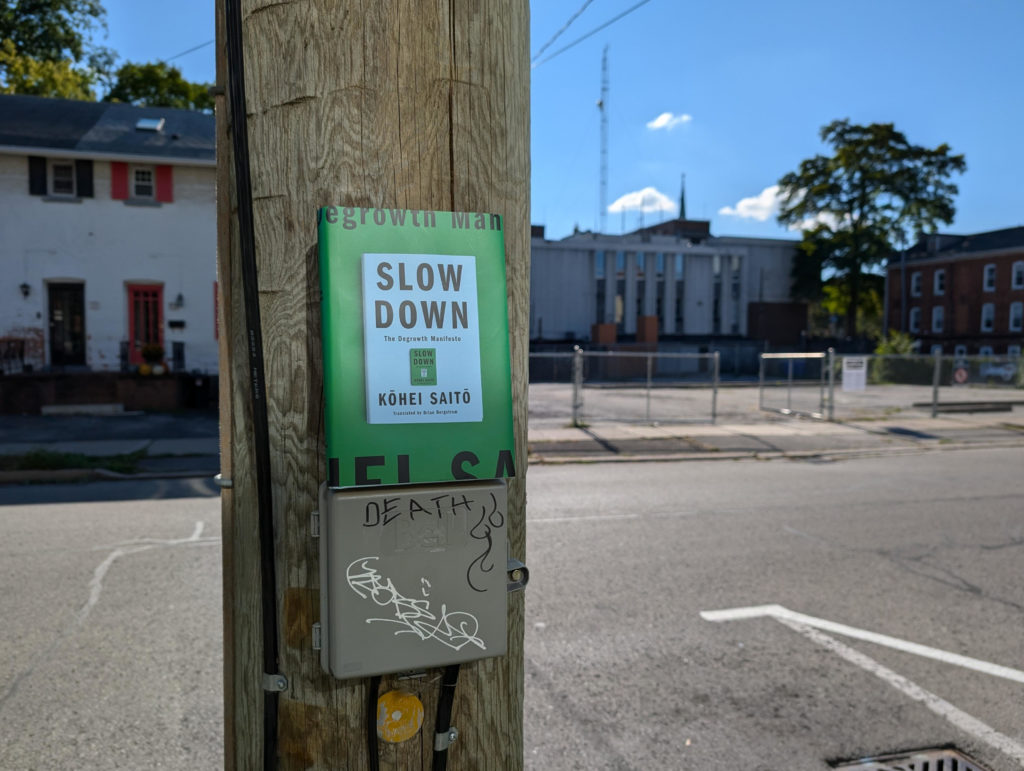
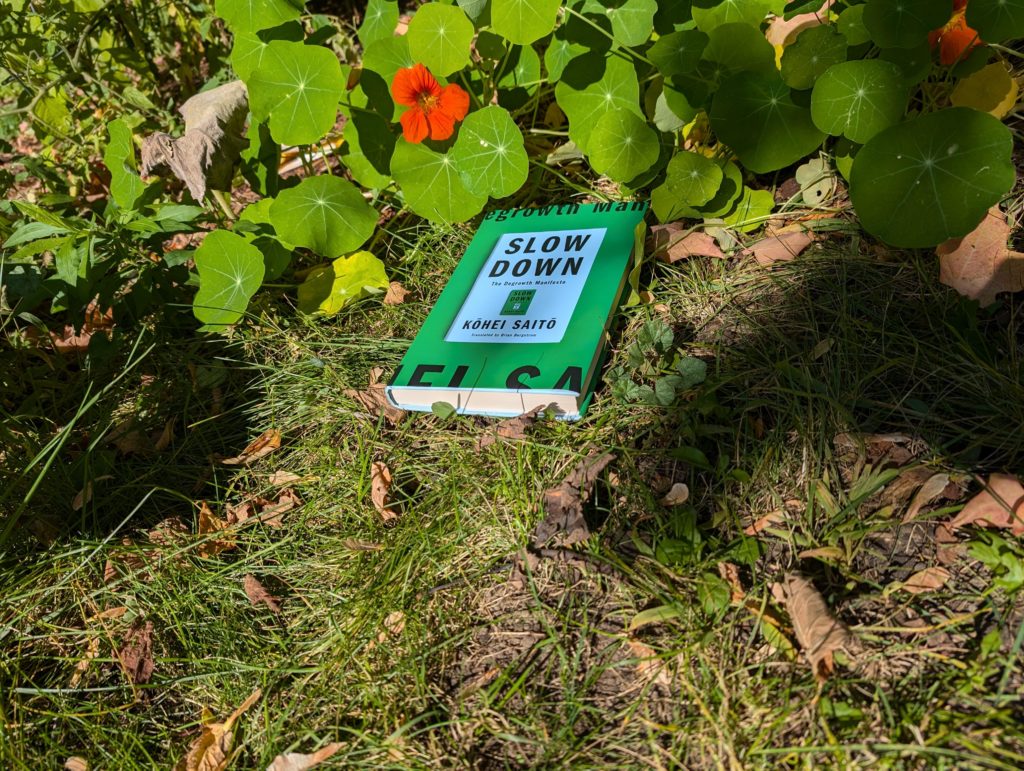
Kōhei Saitō’s Slow Down: A Degrowth Manifesto was originally published in 2020 as Capital and the Anthropocene in Japanese and sold over 500000 copies. Since publishing this somewhat wordy and academic seeming book from a self-described “basically unknown scholar of political thought in the Marxist tradition” (x), Saitō has become somewhat of a celebrity appearing on TV talk shows and receiving coverage and interviews all over the place.
It’s hard to overstate the significance of a degrowth COMMUNIST MANIFESTO selling so many copies in Japan alone and the ensuing pseudo-celebrity of its author, though of course as many are quick to remark, purchasing a book and agreeing with its contents, let alone enacting it, are not quite the same thing. Nonetheless, the left could do with more “ideas lying around,” to quote one of my least favourite men in history…
Reading the book was a buoying experience (in spite of some of the Americanization that the publisher[?] imposed on the text like the use of Fahrenheit; and the boring title; say communism !). Saitō takes dual aim at socialist and environmental movements for their failure to come together. In particular, he pulls apart the very popular arguments for a fully-automated luxury communism which he refers to as left wing “accelerationism” meaning technological (128-129), rather the than violent insurrectionary accelerationism which I would normally associate the term with (Saitō has a real penchant for taking loading terms and using them at considerable remove from their vernacular). Chapters of the manifesto bring together both specific histories of readings of Marx’s as well as Marxist thought with contemporary crises of the environment, affordability, and democracy.
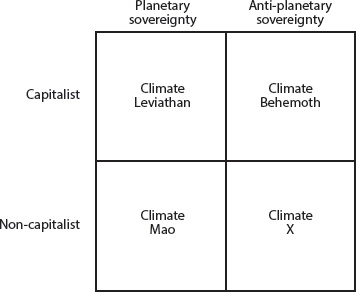
At the heart of Slow Down is an attempt to flesh out a version of Climate X, the only desirable, if sparsely illustrated, option from Geoff Mann and Joel Wainwright’s excellent 2018 book Climate Leviathan: A Political Theory of Our Planetary Future, though you might not realize this if you haven’t read that book because the citational practices of Slow Down are somewhat meagre, inconsistent, and relegated to end notes.
Here is the original chart in Climate Leviathan:
And here’s the version from Slow Down adjusted for Saitō’s analytical concerns:
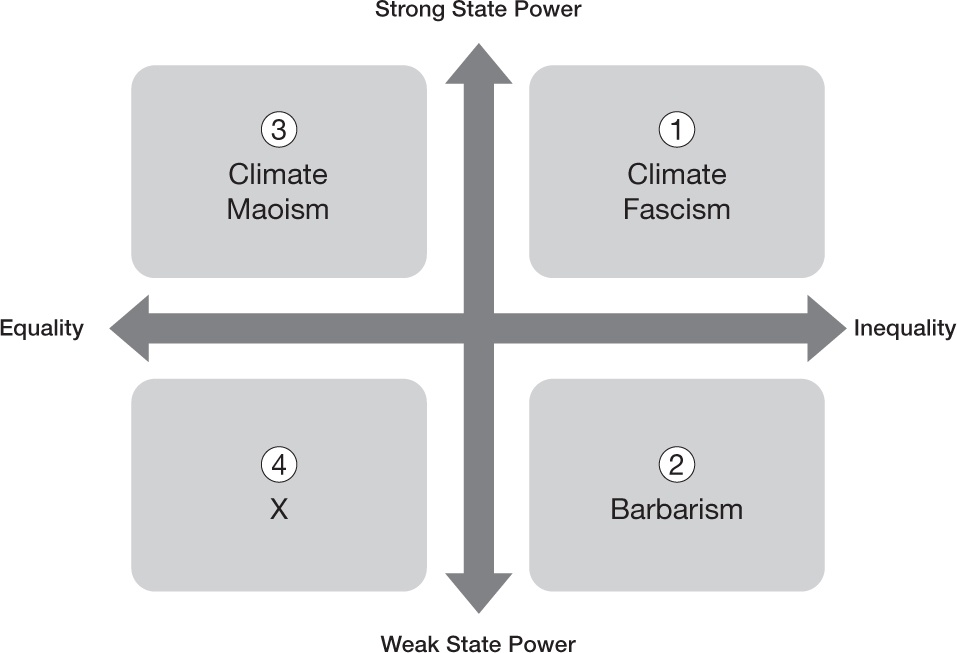
Later developed into this one where he has relabelled Climate X as “Degrowth Communism”:
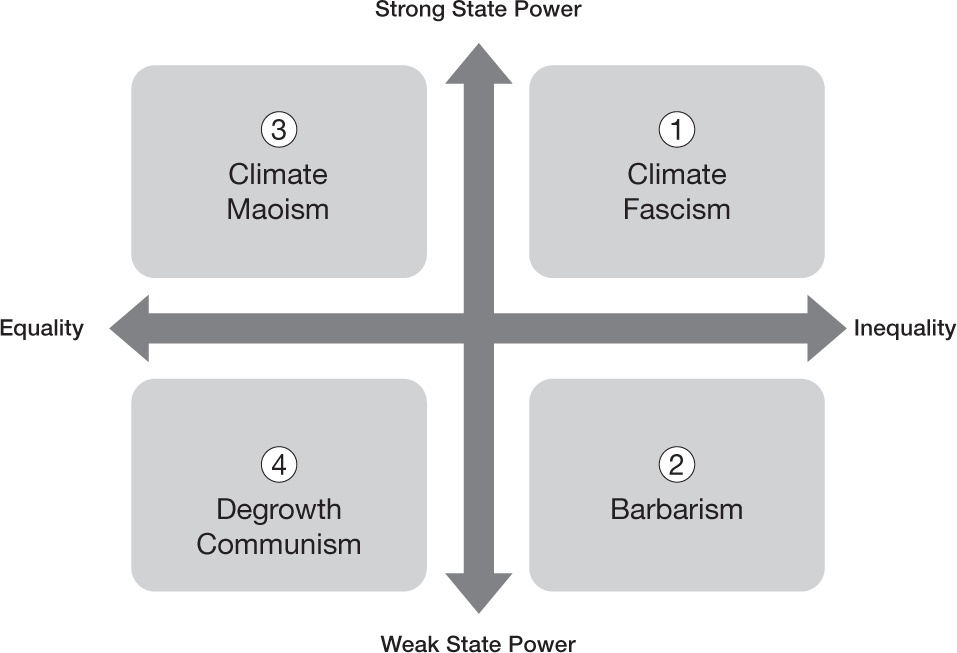
I got a lot out of Climate Leviathan, even if the first chapter was, y’know, devastating (as so many of these books start). Slow Down is a most welcome response and it is thoroughly worth reading for anyone even remotely interested in, well, survival and justice.
What’s most exciting though about Saitō’s manifesto is the way that he so clearly articulates a path forward: “Since capitalism is the ultimate cause of climate breakdown, it is necessary to transition to a steady state [read this loaded phrase as sustainable or a similar word of your choosing] economy. All companies therefore need to become cooperatives or cease trading” (ix), drawing from a heap of contemporary examples of the relationship between democratizing workplaces, degrowth, wellness, survival, and communism. That said, this clarity and certainty also results in the books biggest oversights: anarchism and a reliance on a much cited and much critiqued study on non-violent protest.
I’ll begin with the former before moving to the latter. At the very end of Slow Down, Saitō argues that although he is extremely critical of state power as it has been exercised historically, “it would be foolish to reject the state as a means of getting things done, such as the creation of infrastructure or the transformation of production. Anarchism, which does reject the state, cannot effectively combat climate change” (226-227). Despite this emphatic rejection of the practically of statelessness, he doesn’t give the question much room to breathe. Tellingly, the word “anarchism” doesn’t even get enough mentions to be entered in the Index despite his occasional engagement with anarchist thinkers like David Graeber and the anarchist-adjacent (distinctly not anarchist, but important to add here because of their anti-state formations) Zapatista movement. While settling the state question without deep engagement is a pretty consistent feature of socialist literature that neglects the libertarian branch, it’s still disappointing. Why can’t construction workers’ coops get together with physicists and engineers and delegates from a bunch of municipalities/communes to produce agreements, set goals, and build the required infrastructure? Maybe the state is necessary in some capacity, but Saitō has not convinced me. I was also surprised not to find mention of the Autonomous Administration of North and East Syria (AANES aka Rojava), since it borrows much from Social Ecology and experiments with democracy and ownership in ways that align pretty closely with Saitō project.
The second most concerning piece of Saitō’s book, is his repetition of the claim that 3.5% of a population need to hit the streets non-violently to make meaningful regime change, a stat Extinction Rebellion (XR) frequently uses as their end goal. This idea comes from Chenoweth and Maria J. Stephan’s 2008 study “Why Civil Resistance Works: The Strategic Logic of Nonviolent Conflict” (231). This number however, and the study which produced it, has been called into question by, none other than an anarchist, Peter Gelderloos, in his book The Failure of Nonviolence: From the Arab Spring to Occupy (2013). While the invocation of the 3.5% idea doesn’t punch a massive hole in Saitō’s project, I wanted to make sure that anyone who goes from this review to his book doesn’t end up being the ignorant new-kid-in-the-scene proponent of strategic nonviolence in your local punk house with a total of ONE critical source to back up your claims like I was when I started organizing with XR years ago. The world is too complicated and violence occurs on too many different and conflicting scales and levels of remove to say that only nonviolence works, or to dispel the “by any means necessary” argument.
Okay, phew, sorry, had to get those frustrations out. Those two, admittedly long paragraphs are pretty much the only bits of the manifesto I have a real problem with, which, considering it’s a full length book, is pretty damn good. And if I’m ever going to agree completely with any manifesto, surely it’d only be one I write, but even then I bet I’d have a bone to pick with it 20 minutes after I’d posted it somewhere. More importantly than my ideological alignment with the book, is what you think of it (and maybe of my criticisms). So read the damn thing! And then write you own thing. And then bring about the beautiful perpetual revolution of our collective hearts!
xoxo
Works Cited
Doctorow, Cory. “Ideas Lying Around.” Pluralistic: Daily Links from Cory Doctorow, 12 June 2023, https://pluralistic.net/2023/05/27/ideas-lying-around/.
Dooley, Ben, and Hisako Ueno. “Can Shrinking Be Good for Japan? A Marxist Best Seller Makes the Case.” The New York Times, 23 Aug. 2023. NYTimes.com, https://www.nytimes.com/2023/08/23/business/kohei-saito-degrowth-communism.html.
Gelderloos, Peter. The Failure of Nonviolence: From the Arab Spring to Occupy. 2013. theanarchistlibrary.org, https://theanarchistlibrary.org/library/peter-gelderloos-the-failure-of-nonviolence.
Hu, Akielly. “Slow down, Do Less: A Q&A with the Author Who Introduced ‘degrowth’ to a Mass Audience.” Grist, 1 Feb. 2024, https://grist.org/economics/slow-down-do-less-a-qa-with-the-author-who-introduced-degrowth-to-a-mass-audience/.
Kilian, Crawford. “A Fresh Take on Marx, Gone Green.” The Tyee, 11 Sept. 2023, https://thetyee.ca/Culture/2023/09/11/Green-Marx/.
Kim, E. Tammy. “Can Slowing Down Save the Planet?” The New Yorker, 1 Feb. 2024. www.newyorker.com, https://www.newyorker.com/books/under-review/can-slowing-down-save-the-planet.
Lewis, Leo. “‘Degrowth’ — Marxism Is Back for the Modern Age.” Financial Times, 6 Nov. 2022, https://www.ft.com/content/b1a505ac-c36f-4b4d-9ab0-6f5d9d0e185d.
Mann, Geoff, and Joel Wainwright. Climate Leviathan. Verso, 2020, https://www.versobooks.com/en-ca/products/520-climate-leviathan.
Maria J. Stephan and Erica Chenoweth. “Why Civil Resistance Works: The Strategic Logic of Nonviolent Conflict.” Int. Secur., vol. 33, no. 1, 2008.
McCurry, Justin. “‘A New Way of Life’: The Marxist, Post-Capitalist, Green Manifesto Captivating Japan.” The Guardian, 9 Sept. 2022. The Guardian, https://www.theguardian.com/world/2022/sep/09/a-new-way-of-life-the-marxist-post-capitalist-green-manifesto-captivating-japan.
Phillips, Leigh, and Matt Huber. “Kohei Saito’s ‘Start From Scratch’ Degrowth Communism.” Jacobin, 3 Sept. 2024, https://jacobin.com/2024/03/kohei-saito-degrowth-communism-environment-marxism.
Saitō, Kōhei. Slow Down: The Degrowth Manifesto. Translated by Brian Bergstrom, Astra House, 2024, https://astrapublishinghouse.com/product/slow-down-9781662602368/.
Edits
2025/05/16 to correct an “it’s” to an “its.”
Leave a Reply